|
The Publick Universal Friend
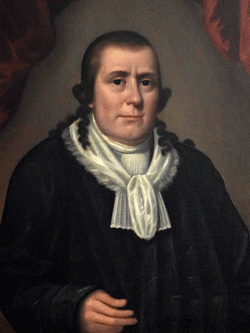
Between 1788 and 1790, The Public Universal Friend (born Jemima Wilkinson in 1752) brought 260 believers to Yates County, creating the Society of Universal Friends, the largest settlement in western New York State. A powerful preacher and forceful personality, the Friend espoused plain dress, pacifism and the emancipation of slaves. The sect declined after the Friend’s death in 1819, and today, Yates County History Center owns the largest known collection of artifacts and manuscript materials relating to the Friend and the community. These collections include the portrait, the Friend's hat and bible, gifts given by visitors to the community including Seneca baskets and a pocketbook from a French aristocrat, and items of daily use including pewter, china, chairs and a saddle. Manuscript materials include the Friend’s last will and testament, the Society's Death Book, and a large body of correspondence and other written materials.
L. Caroline Underwood
Throughout her life, Caroline accumulated a variety of objects included collectibles such as her renowned pink ceramic pigs, travel souvenirs, menus, Royal Copenhagen Christmas plates, cups and saucers; family-related material such as furniture and hand-made quilts; antique toys; fine clothes, shoes and jewelry, and a host of other items from both the 19th and 20th centuries. In addition, Caroline specified that she wished to be placed on permanent display 44 objects that had special meaning to her. These objects are incorporated into the long term exhibit at the L. Caroline Underwood Museum entitled, Caroline Underwood: Collector, Teacher Traveler.
|
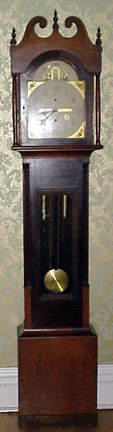
| The Oliver grandfather clock was manufactured by Riley Whiting in Connecticut circa 1820. The original works were wooden but have been replaced. |
|
Furniture
Incorporating the Oliver family collection of early 19th century pieces with the History Center's collection of eighteenth and nineteenth century furnishings, four rooms within the house are portrayed in Victorian period style. Other period pieces both earlier and later are also on display.
Costumes/Textiles
From Adam Hunt's 1760 wedding vest to the polyester leisure suits of the 1970's, our extensive collection of costumes include fine examples of styles, fabrics and design throughout this time period. Along with numerous accessory pieces, a fine collection of quilts and textiles round out our collection. The objects are frequently on display.
Agricultural, Carpentry and Blacksmithing Tools
Our many agricultural implements and carpentry/blacksmithing tools give insight into the tasks performed to build and maintain the communities of Yates County.
Domestic tools
Just as the agricultural, carpentry and blacksmithing tools were used mainly by men, the domestic tools such as churns, walking and flax wheels, candle molds, irons and other household items assisted women as they went about their daily tasks of every day living.
 Military Military
Our collection includes pieces from the War of 1812 through the Korean Conflict. Consisting of uniforms, arms, medals, and the day-to-day tools used in the different wars, the collection also contains a number of manuscripts and documents.
Native American Artifacts
Our collection centers on the Eastern Woodlands Indians who inhabited our area, particularly the Seneca Nation (Onondowahgah), “People of the Great Hill”. The Seneca Nation’s origin is recognized as being within the Town of Middlesex, Yates County. The Senecas are one of the original five nations that comprised the Haudenosaunee (“People of the Longhouse”) Confederacy, also known as the Iroquois Confederacy. Our collection includes a great number of points, mortars and pestles, celts, axe heads, and other stone tools, trade beads, birdstones, a pair of 1890’s moccasins, a cradleboard, baskets and a tanned decorative hide. We also have “hands-on” items and several reference books.
 Decorative Arts Decorative Arts
The Oliver House collection consists of a variety of decorative arts popular in Yates County through the eighteenth and nineteenth centuries. Among our pieces is a particularly fine collection of flow blue china owned by the Oliver family.
Paintings
The Society has a fine collection of portraits in oil, charcoal and watercolor of early settlers and prominent figures in Yates County. Paintings of landscapes are also on display.
Photographs/Postcards
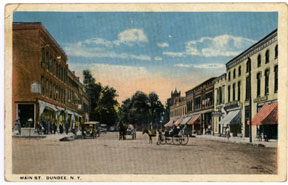 Our unusually rich photograph collection contains items dating from 1850 to the present, consisting of a large number of antique postcards, paper prints, slides (modern and lantern), daguerreotypes, ambrotypes, tin-types, negatives (glass and film), hand-colored black and white prints, stereographs, and photo albums. Themes include transportation, steamboat traffic, railroads and trolley, businesses, Keuka Lake, churches, schools, residences, special events- parades, circuses, fairs and festivals, military, and special collections such as the slides of Verdi Burtch, noted ornithologist. Our unusually rich photograph collection contains items dating from 1850 to the present, consisting of a large number of antique postcards, paper prints, slides (modern and lantern), daguerreotypes, ambrotypes, tin-types, negatives (glass and film), hand-colored black and white prints, stereographs, and photo albums. Themes include transportation, steamboat traffic, railroads and trolley, businesses, Keuka Lake, churches, schools, residences, special events- parades, circuses, fairs and festivals, military, and special collections such as the slides of Verdi Burtch, noted ornithologist.
|